


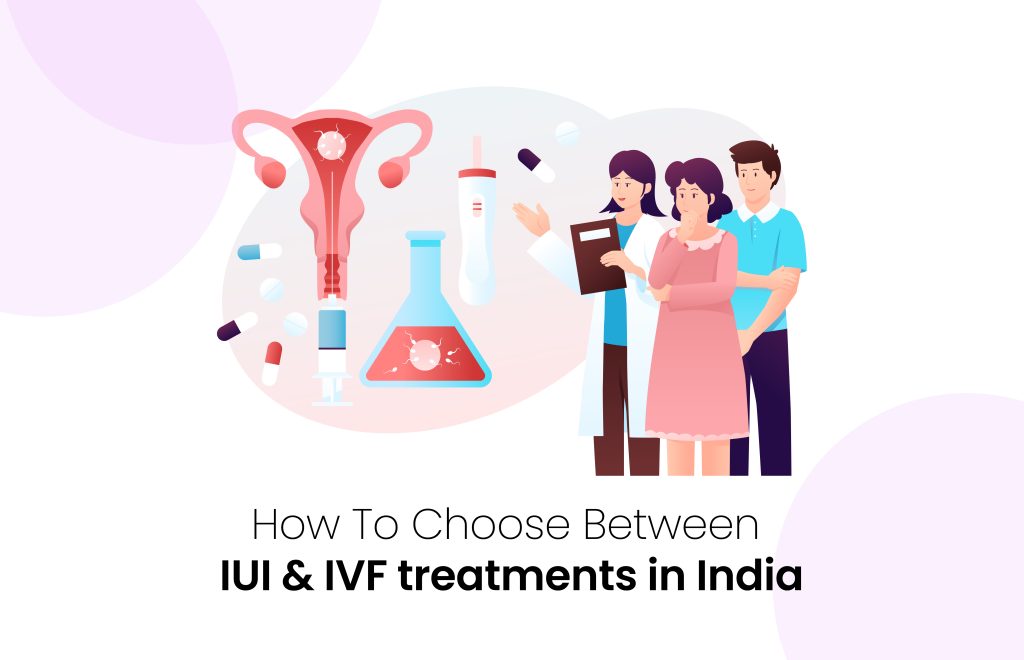
Neither IUI nor IVF is “better” in every case. IUI is simpler, less invasive, and more affordable, while IVF has significantly higher success rates and can treat more complex fertility problems. The right choice depends on your age, diagnosis, how long you’ve been trying, and your budget which is exactly what this guide walks you through.
Key Differences at glance – IVF Vs IUI
| Names | IUI | IVF |
| Full form | Intrauterine Insemination | In Vitro Fertilization |
| How it works | Washed sperm is placed directly into the uterus around ovulation | Eggs are retrieved, fertilised with sperm in a lab, and the embryo is placed in the uterus |
| Success rate per cycle | ~10-20%, depending on age and cause | ~40-60% for women under 35; declines with age |
| Best for | Unexplained infertility, mild male-factor infertility, donor sperm cycles | Blocked fallopian tubes, severe male infertility, low ovarian reserve, failed IUI, advanced maternal age |
| Average cost in India (per cycle) | ₹3,000 – ₹15,000 | ₹90,000 – ₹2,50,000 (higher with ICSI, PGT, or donor eggs) |
| Invasiveness | Minimal no anaesthesia, no surgery | Moderate involves hormone injections and a minor egg-retrieval procedure |
| Time per cycle | About 2 weeks (in line with a natural cycle) |
About 4-6 weeks from stimulation to embryo transfer |
| Genetic testing of embryo possible? | No | Yes (PGT-A/PGT-M) |
| Age | IUI works best under 35 | IVF is usually recommended sooner with low AMH or age 35+. |
| Suitability | IUI suits mild or unexplained cases | IVF suits blocked tubes, severe male-factor infertility, or low egg count/quality. |
Success rates and costs vary by clinic, age, and diagnosis. The figures above are general India/global averages ask your fertility specialist for numbers specific to your case.
What Is IUI (Intrauterine Insemination)?
IUI is a fertility treatment where a specially “washed” and concentrated sperm sample is placed directly into the uterus using a thin, soft catheter, timed to match ovulation. This shortens the distance sperm has to travel and increases the number of healthy sperm reaching the fallopian tubes, improving the chance of natural fertilisation.
How the IUI Procedure Works – Step by Step
- Ovulation tracking Your natural cycle is monitored (or mildly stimulated with oral/injectable medication) using ultrasound scans and hormone tests to pinpoint ovulation.
- Sperm collection and washing A semen sample is collected and processed in the lab to separate healthy, motile sperm from seminal fluid and debris.
- Insemination The concentrated sperm sample is inserted into the uterus through the cervix using a thin catheter a quick, painless outpatient procedure that takes only a few minutes.
- Two-week wait You can resume normal activities immediately; a pregnancy blood test is usually done about 2 weeks later.
Who Is a Good Candidate for IUI?
- Couples with unexplained infertility
- Mild male-factor infertility (slightly low sperm count or motility)
- Women with ovulation irregularities using ovulation-inducing medication
- Women using donor sperm, or single women/same-sex couples building a family
- Cases where both fallopian tubes are open and healthy
IUI Success Rate
IUI success rates typically range from about 10% to 20% per cycle, depending on the woman’s age, the cause of infertility, and whether ovulation-stimulating medication is used. Because the per-cycle rate is modest, IUI is often attempted over 2-3 cycles before deciding whether to continue or move to IVF.
What Is IVF (In Vitro Fertilization)?
IVF is a more advanced fertility treatment where eggs are retrieved directly from the ovaries and fertilised with sperm in a laboratory (“in vitro” means “in glass”). The resulting embryo is cultured for a few days and then transferred into the uterus to establish a pregnancy. Because fertilisation happens outside the body under controlled lab conditions, IVF can overcome many fertility barriers that IUI cannot.
How the IVF Procedure Works – Step by Step
- Ovarian stimulation Daily hormone injections (typically 8-12 days) stimulate the ovaries to produce multiple mature eggs instead of just one.
- Egg retrieval A minor, ultrasound-guided procedure under light sedation collects the mature eggs directly from the ovaries; it takes about 15-20 minutes.
- Fertilisation Eggs are fertilised with sperm in the lab, either through conventional IVF (sperm and egg combined in a dish) or ICSI (a single sperm is injected directly into the egg), used for male-factor cases.
- Embryo culture Fertilised eggs are monitored in the lab for 3-5 days as they develop into embryos, often to the blastocyst stage.
- Embryo transfer One healthy embryo (occasionally two) is placed into the uterus using a thin catheter a quick procedure that does not need anaesthesia.
- Pregnancy test A blood test about 2 weeks after transfer confirms whether implantation was successful.
Who Is a Good Candidate for IVF?
- Blocked or damaged fallopian tubes
- Severe male-factor infertility (very low sperm count, motility, or morphology)
- Low ovarian reserve or advanced maternal age (generally 35+)
- Endometriosis or significant pelvic scarring
- Couples who have had 2-3 failed IUI cycles
- Anyone who needs or wants genetic testing of embryos (PGT-A/PGT-M) before transfer
- Same-sex couples or individuals using donor eggs, donor sperm, or a gestational surrogate
IVF Success Rate
IVF success rates are meaningfully higher than IUI generally 40-60% per cycle for women under 35, gradually declining with age (typically dropping into the 20-30% range by the late 30s, and lower after 40). Because it treats the fertilisation and implantation stages directly, IVF remains effective even for many complex cases where IUI would not work at all.
IUI vs IVF: Key Differences at a Glance
- Root Cause of Infertility: IUI works well for unexplained infertility, mild male-factor issues, or ovulation problems, where the main barrier is getting enough healthy sperm close to the egg. IVF is typically necessary for blocked tubes, severe male infertility, or low egg count/quality, where fertilisation or transport itself is the problem.
- Age: Age affects both treatments, but it affects IUI success more steeply. Doctors often recommend women over 35, or with a low AMH/ovarian reserve, consider IVF sooner rather than spending time on multiple IUI cycles.
- Previous Treatment Outcomes: If 2-3 IUI cycles haven’t resulted in pregnancy, most specialists recommend moving to IVF rather than repeating IUI further, since the additional cycles rarely change the odds much once the underlying cause hasn’t shifted.
- Cost: IUI costs approximately ₹10,000-₹35,000 per cycle in India. IVF costs approximately ₹1,20,000-₹2,50,000 per cycle, and can go higher with add-ons like ICSI, PGT-A genetic testing, or donor eggs. Because IVF often has a higher per-cycle success rate, some patients spend less overall reaching a pregnancy with fewer IVF cycles than with many repeated IUI attempts but this varies case by case.
- Time Commitment: An IUI cycle typically takes about 2 weeks, closely following a natural or mildly-stimulated cycle. An IVF cycle typically takes 4-6 weeks from the start of stimulation to the embryo transfer, with more frequent clinic visits for monitoring.
- Invasiveness: IUI needs no anaesthesia and no surgery it’s a quick, in-clinic procedure. IVF involves daily injections and a minor surgical egg retrieval under sedation, making it more physically demanding, though still a same-day outpatient procedure.
When Should You Choose IUI Over IVF?
IUI is usually the recommended first step when:
- Infertility is unexplained, or the cause is mild
- The woman is under 35 with a healthy ovarian reserve
- At least one fallopian tube is open and healthy
- Male-factor infertility is mild, not severe
- Cost and lower invasiveness are important priorities
When Should You Choose IVF Over IUI?
IVF is usually recommended directly, without trying IUI first, when:
- Both fallopian tubes are blocked or damaged
- Male-factor infertility is severe (very low count, motility, or abnormal morphology)
- The woman is 35+ with declining ovarian reserve, or has a very low AMH
- There’s a genetic condition that needs embryo screening before transfer
- 2-3 IUI cycles have already failed
- Same-sex couples or individuals need donor eggs, donor sperm, or a surrogate
How Oasis Fertility Helps You Choose the Right Treatment
At Oasis Fertility, the choice between IUI and IVF is never made on a template it’s based on a detailed fertility evaluation of both partners, including hormone levels, ovarian reserve (AMH), tubal patency, and semen analysis. Our specialists talk you through the realistic success rate for your specific case with each option, so you can make a confident, informed decision rather than guessing.
We offer both IUI and IVF (including ICSI, PGT-A genetic testing, and advanced lab techniques) under one roof across our centres in India, with transparent cost breakdowns and EMI options to make treatment more accessible.
Book a free consultation with Oasis Fertility to get a personalised recommendation on whether IUI, IVF, or another treatment path is the right next step for you.