


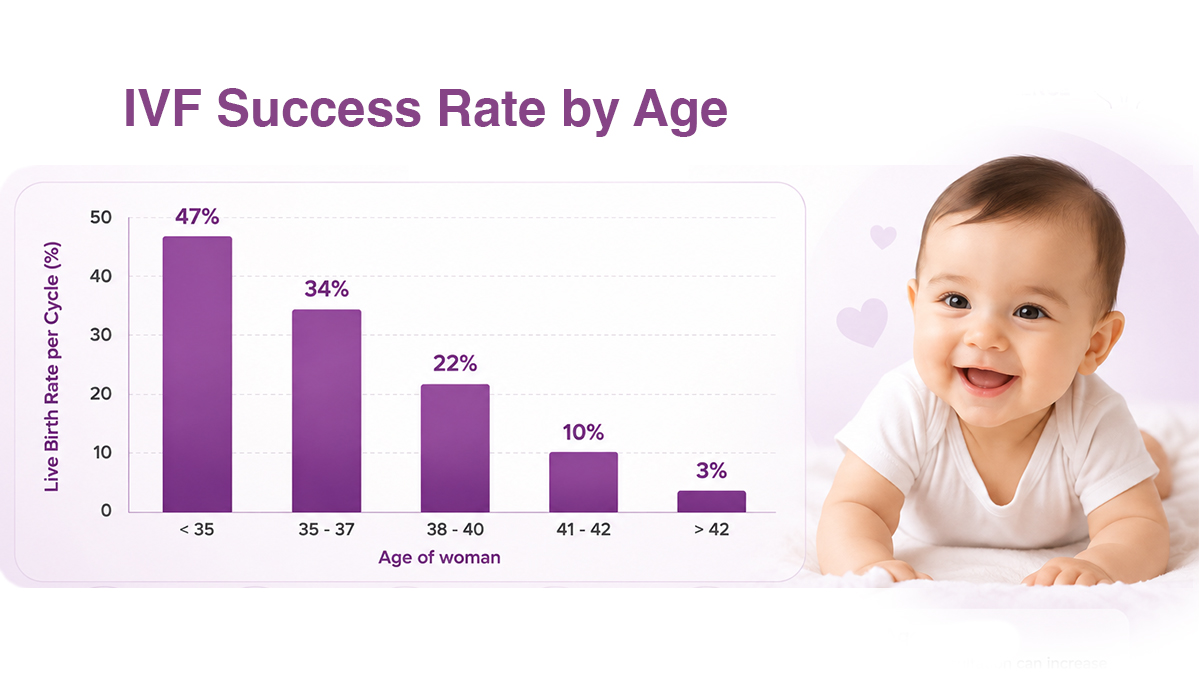
IVF success rates generally decrease with age when using your own eggs, with the highest rates typically seen in women under 35 and a progressive decline after 35. However, age alone does not determine IVF success. Ovarian reserve, egg and embryo quality, sperm factors, infertility diagnosis, treatment protocol and IVF laboratory practices can also influence the chance of a successful pregnancy and live birth.
For patients using their own eggs, indicative IVF live birth rates per treatment cycle may range from approximately 50–65% for women under 35 to below 10% for women above 42, depending on the population and how success is measured. Donor eggs and cumulative outcomes across multiple IVF cycles may substantially change the overall chances of success for appropriately selected patients.
IVF Success Rate by Age, Per Cycle
|
Age Group |
Live Birth Rate Per IVF Cycle (Own Eggs) |
|
Under 35 |
50% – 65% |
| 35 – 37 |
35% – 45% |
|
38 – 40 |
20% – 35% |
| 41 – 42 |
10% – 20% |
|
Above 42 |
Under 5% – 10% |
| Any age, using donor eggs |
60% – 70% |
Note: These success rates are indicative ranges based on national fertility-registry benchmarks and published clinical data. They are not a prediction or guarantee of an individual’s chance of pregnancy or live birth. Reported IVF success rates can vary depending on the patient population, age, egg source, ovarian reserve, sperm factors, embryo quality, treatment protocol and IVF laboratory practices. Success may also be reported using different measures, such as per cycle, egg retrieval or embryo transfer, so rates should only be compared when the underlying methodology is similar.
Key Factors That Affect IVF Success Rates
- Age and egg quality: Egg quality generally declines with age and is an important factor affecting embryo development and IVF outcomes.
- Ovarian reserve: AMH, antral follicle count and ovarian response can help assess ovarian reserve and guide treatment planning.
- Embryo quality: Embryo development and chromosomal factors can influence implantation and live birth.
- Sperm quality: Sperm concentration, motility, morphology and other male-factor considerations can affect fertilisation and embryo development.
- IVF laboratory quality: Embryology expertise, laboratory conditions, blastocyst culture and quality-control practices can influence treatment outcomes.
- Treatment strategy: Individualised stimulation, fertilisation and embryo-transfer strategies may affect outcomes.
- Cumulative treatment: For some patients, completing multiple IVF cycles can increase the overall cumulative chance of achieving a live birth, although individual outcomes vary.
Why Choose Oasis Fertility for Successful IVF?
At Oasis Fertility, our focus is on achieving the best possible IVF outcomes through a combination of experienced fertility specialists, advanced IVF technology, skilled embryology teams and personalised treatment protocols. Every IVF cycle is planned according to individual factors such as age, ovarian reserve, sperm quality, embryo development and previous treatment history.
Our IVF centres follow structured clinical and laboratory protocols, with careful monitoring at every stage—from ovarian stimulation and egg retrieval to fertilisation, embryo development and transfer. This integrated approach is designed to maximise the individual chances of pregnancy and live birth, while maintaining evidence-based standards of fertility care.
Why Does Age Affect IVF Success So Much?
A woman is born with all the eggs she will ever have around 1-2 million at birth, dropping to roughly 300,000 – 500,000 by puberty, and declining steadily after that. By the mid-to-late 30s, both the number and the genetic quality of remaining eggs fall sharply, which increases the rate of chromosomally abnormal embryos and, in turn, lowers implantation and live birth rates while raising miscarriage risk. This is the single biggest reason IVF success rates decline with age it isn’t primarily about the uterus or the procedure itself, but the eggs.
IVF Success Rate by Age Group: The Full Breakdown
IVF Success Rate Under 35
Women under 35 have the highest per-cycle success rates, generally in the 50-55% range for a live birth per cycle, and even higher in some reported single-clinic data. Egg quantity and quality are at their best in this age group, so even complications like mild male-factor infertility or a low egg count are more manageable. Cumulative live birth rates after 2-3 complete IVF cycles can reach 70-80% in this age group.
IVF Success Rate at 35-37
Success rates begin a gradual decline in this range, typically landing between 35% and 45% per cycle. Egg quality starts to decrease more noticeably here, though most women in this group still respond well to ovarian stimulation and produce good-quality embryos.
IVF Success Rate at 38-40
Success rates drop more steeply in this age band, generally to 20-35% per cycle. This is often the point where fertility specialists start discussing realistic expectations around the number of cycles likely needed, and may recommend additional testing such as PGT-A (genetic testing of embryos) to select the most viable embryo for transfer.
IVF Success Rate at 41-42
Success rates fall further to roughly 10-20% per cycle using the woman’s own eggs. At this stage, egg quantity and quality have declined enough that many specialists proactively discuss donor eggs as an option to significantly improve the odds, alongside continuing with own-egg cycles if that is the patient’s preference.
IVF Success Rate After 42
Success rates using a woman’s own eggs typically fall under 5-10% per cycle past 42, and continue to decline with each passing year. Own-egg IVF can still succeed for some women in this age group, particularly those with a good ovarian reserve for their age, but donor eggs are usually presented as the option with substantially better odds.
How Donor Eggs Impact IVF Success Rate?
Because live birth success in IVF is driven overwhelmingly by egg quality rather than the age of the uterus, using donor eggs from a younger woman can raise success rates to 60-70% per cycle, largely independent of the recipient’s own age. This is why donor egg IVF is often recommended once own-egg success rates fall into the single digits the uterus of a woman in her 40s or even early 50s can generally still carry a pregnancy successfully when the embryo comes from a younger egg.
Cumulative IVF Success Rate: What Happens Over 2-3 Cycles?
Per-cycle success rates only tell part of the story. Because IVF outcomes accumulate, most fertility specialists look at cumulative live birth rate the chance of success across a complete course of 2 to 3 cycles rather than a single attempt. For women under 35, cumulative live birth rates after 2-3 cycles can reach 70-80%, meaningfully higher than any single cycle’s odds. This is a key reason specialist often recommend planning for the possibility of more than one cycle from the outset, rather than judging IVF’s potential on a single attempt.
What Else Affects IVF Success, Beyond Age?
- Ovarian reserve (AMH level) a low AMH can lower success rates even in younger women, while a good AMH can support better-than-average odds even in the late 30s.
- Sperm quality severe male-factor infertility or high sperm DNA fragmentation can lower fertilisation and embryo quality regardless of the woman’s age.
- Underlying conditions endometriosis, uterine fibroids, polyps, or a thin endometrial lining can all affect implantation independent of age.
- Number of embryos available and PGT-A testing having more embryos to choose from, or knowing which embryo is chromosomally normal, improves the odds of selecting one likely to implant.
- Clinic and lab quality experienced embryologists, advanced blastocyst culture techniques, and strict lab quality control measurably affect outcomes at every age.
- Lifestyle factors smoking, high BMI, and uncontrolled conditions like thyroid disorders or diabetes can modestly reduce success rates.
How To Choose Right IVF Clinic In India?
India has one of the fastest-growing IVF sectors in the world, with the number of clinics and annual treatment cycles rising sharply over the past two decades. Success rates broadly follow the same global age-based ranges described above. Costs and lab standards vary meaningfully across clinics, so choosing a centre with strong embryology lab standards and transparent success-rate reporting matters as much as age when it comes to realistic expectations.
When Should You Start Considering IVF?
- Under 35: consider a fertility consultation after 12 months of trying to conceive without success, or sooner if you notice signs like irregular periods or a known fertility condition.
- 35 and older: consider a consultation after 6 months of trying, since time has a bigger impact on outcomes at this stage.
- Known conditions such as blocked fallopian tubes, severe male-factor infertility, low ovarian reserve, or a previous cancer treatment affecting fertility are reasons to consult a specialist sooner, regardless of age.
How Oasis Fertility Supports Your IVF Journey at Any Age
At Oasis Fertility, every IVF plan starts with an individual assessment of ovarian reserve (AMH), egg and sperm quality, and uterine health not a generic, age-based protocol. For patients in age groups where success rates naturally decline, our specialists discuss realistic options clearly and early, including advanced techniques like ICSI, PGT-A genetic testing, and donor egg programmes, along with transparent guidance on the number of cycles that may realistically be needed.
We also provide clear financial planning support, including EMI options, so that the number of cycles required doesn’t become a barrier to treatment.
Book a free consultation with Oasis Fertility to get a personalised estimate of your IVF success rate based on your own age, ovarian reserve, and health profile not just a generic age bracket.