


Your doctor told you the embryo was “good quality.” Everything looked fine on paper. But the pregnancy test still came back negative.
This is very confusing. You may be thinking if the embryo was good, then why did it not work?
Here is the simple answer:
A good embryo does not always mean a successful pregnancy. A “good” embryo just means it looks healthy under a microscope. It does not tell us everything about the embryo’s genes. It also does not tell us if the uterus (womb), hormones, and body were fully ready to accept it.
Implantation (the embryo attaching to the uterus) needs two things to be right at the same time a healthy embryo AND a uterus that is ready. If even one side is not ready, the cycle can fail.
At Oasis Fertility, many patients ask this same question after a failed IVF cycle. This article explains, in very simple words, all the reasons this can happen and what you can do next.
In Short (Quick Summary)
- A “good” embryo only means it looks good. It does not always mean the embryo is genetically normal.
- Even a good embryo has only about a 35–55% chance of becoming a pregnancy. It is not a 100% guarantee.
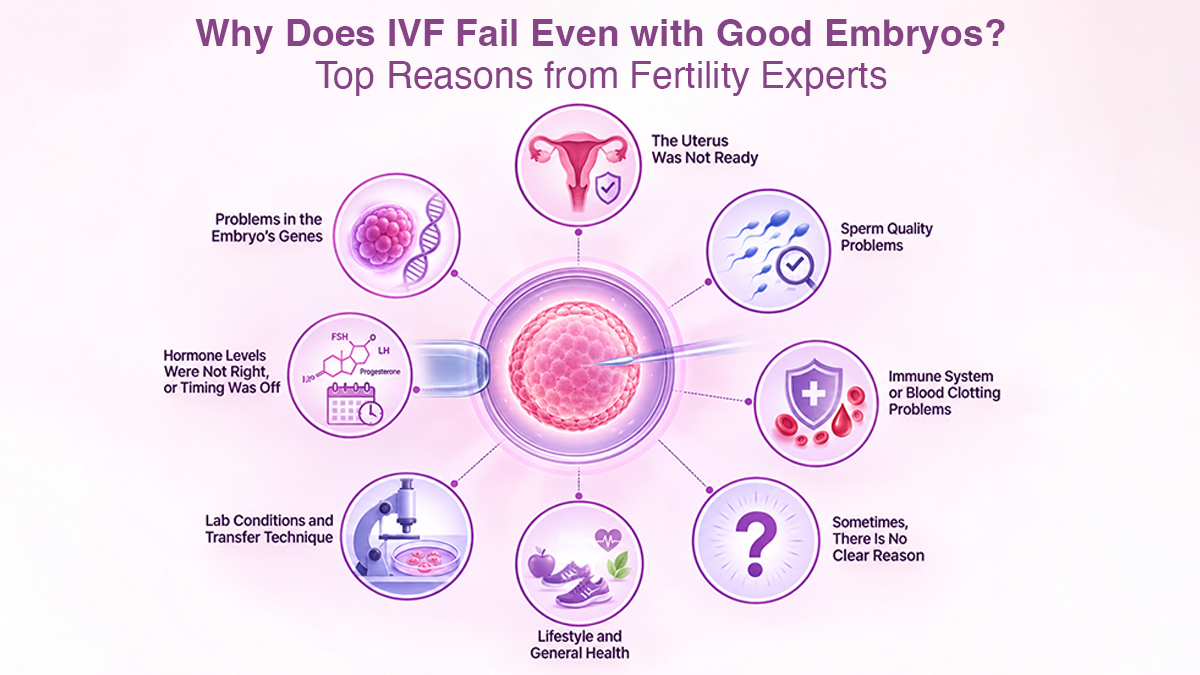
- IVF can fail because of the embryo’s genes, the uterus, hormones, sperm quality, immune system, blood clotting, lab conditions, or lifestyle.
- Your first IVF cycle often fails. This is normal. Doctors learn a lot from the first try and use it to plan the next one better.
- If 2 or more cycles fail with good embryos, doctors will usually do deeper tests to find the reason.
What Does “Good Embryo” Really Mean?
When doctors say an embryo is “good,” they mean the embryologist (embryo expert) looked at it under a microscope and it looked healthy. They check things like:
- How many cells it has
- How the cells are shaped
- How fast it is growing
This is called grading. An embryo can get a high grade, like “top quality.”
But here is the important part: grading only checks how the embryo looks. It does not check the embryo’s genes.
An embryo can look perfect on the outside but still have:
- Wrong number of chromosomes (this is called a genetic or chromosomal problem)
- Weak energy making parts inside its cells (called mitochondria)
- Problems “talking” to the uterus lining during implantation
This is why even a top grade embryo can still fail to become a pregnancy.
Top Reasons Why IVF Fails Even With Good Embryos
- The Uterus Was Not Ready
Even the best embryo cannot implant if the uterus (womb) is not ready. Doctors usually want the uterus lining to be at least 7–8 mm thick with good blood flow before doing the embryo transfer.
Problems that can stop the uterus from being ready:
- Fibroids, polyps, or scar tissue inside the uterus
- Thin lining that does not grow enough
- Chronic endometritis this is a mild, silent infection or swelling inside the uterus lining. Many women don’t even know they have it. A simple test can check for this.
- Adenomyosis a condition where the uterus muscle has some issues, which can affect blood flow
Good news: many of these problems can be found using a small test called hysteroscopy, and can often be treated.
- Problems in the Embryo’s Genes
This is one of the biggest reasons for failure. Even a “good looking” embryo can have a wrong number of chromosomes. This is called a chromosomal problem, and normal grading cannot catch it only genetic testing can.
This risk becomes higher as the woman’s age increases, especially after age 35.
To check for this, doctors may suggest a test called PGTA (Preimplantation Genetic Testing for Aneuploidy). This test checks the embryo’s genes before it is transferred into the uterus.
- Hormone Levels Were Not Right, or Timing Was Off
There is a small window of time just a few days when the uterus is ready to accept the embryo. This is called the “window of implantation.”
If the transfer happens even 1–2 days too early or too late, it can fail even with a good embryo. This can happen because of:
- Low or badly timed progesterone (a hormone needed to prepare the uterus)
- Thyroid problems that were not treated
- Insulin resistance (a condition linked to blood sugar)
- A shifted window of implantation some clinics use a test called ERA (Endometrial Receptivity Array/Analysis). This test checks the exact day your uterus is most ready, so future transfers can be timed better.
- Sperm Quality Problems
Many people forget that sperm also plays a big role even after the embryo is formed.
- Sperm DNA fragmentation means the sperm’s genetic material (DNA) has some damage. Even if the embryo looks fine at first, this damage can stop it from growing properly later.
- A normal semen test does not check this. A special test, called a DFI test (DNA Fragmentation Index), is needed to find this problem.
- Immune System or Blood Clotting Problems
For some people, the body’s immune system or blood clotting can affect implantation. This does not happen to everyone, but it is worth knowing about:
- Autoimmune conditions, like thyroid autoimmune disease
- Chronic swelling (inflammation), often linked to conditions like endometriosis
- Blood clotting disorders (also called thrombophilia) this means the blood clots more than normal, which can reduce blood flow to the area where the embryo tries to implant. This can also sometimes cause early pregnancy loss.
Doctors usually check for these only after checking the more common reasons first.
- Lab Conditions and Transfer Technique
The IVF lab itself also matters a lot. Small things like temperature, air quality, and how carefully the embryo is handled can affect the result. The skill and timing of the doctor doing the embryo transfer also matters.
This is one reason why choosing a clinic with a good, well-equipped lab and experienced team is so important it’s not just about the embryo grade.
- Lifestyle and General Health
Things like smoking, drinking alcohol, high stress, poor sleep, or being very underweight or overweight can affect your hormones and reduce the chances of success. These things alone rarely cause failure but combined with other problems, they can make a difference.
The good news: these are things you can improve before your next try.
- Sometimes, There Is No Clear Reason
Sometimes, everything is checked and everything looks normal good embryo, good lining, normal hormones, normal sperm. But the cycle still does not work.
This is very hard to accept, but it does not mean something is wrong with you. The human body does not work like a machine. Even science cannot explain every single case. In such situations, a detailed review with a specialist is the best way forward.
Why Does the First IVF Cycle Often Fail?
If your first IVF cycle did not work, please know this is very common. Doctors often say the first cycle teaches them a lot, even if it does not result in a pregnancy. It shows:
- How your body reacted to the fertility medicines
- How your eggs turned into embryos
- How your uterus lining responded to hormones
- What timing worked best for your transfer
Using this information, doctors can make better choices for your next cycle. Many people who don’t succeed in cycle 1 do succeed in cycle 2 or cycle 3, once the plan is adjusted.
What if IVF Keeps Failing? (Recurrent Implantation Failure)
If you have had 2 or more failed transfers with good quality embryos, doctors call this Recurrent Implantation Failure (RIF). At this point, your doctor will usually suggest deeper testing, such as:
- Hysteroscopy (checking the uterus)
- Biopsy to check for chronic endometritis
- Sperm DNA fragmentation test
- PGTA genetic testing on embryos
- ERA test to check timing
- Blood tests for clotting and immune issues
The goal is not to just repeat the same cycle again. The goal is to find out exactly what needs to change.
Quick Checklist: Questions to Ask Your Fertility Doctor
Before your next IVF cycle, it may help to ask your doctor these simple questions:
- Have my embryos been tested with PGTA (genetic testing)?
- Has the timing of my uterus lining been checked with an ERA test?
- Has my uterus lining been checked for infection or inflammation (chronic endometritis)?
- Has my partner’s sperm been tested for DNA fragmentation?
- Have blood clotting and immune factors been checked, especially if I’ve had more than one failed cycle or an early loss?
Bringing this list with you can make your next consultation much more useful.
What Should You Do After a Failed IVF Cycle?
- Take your time. A failed cycle is a real loss. It is okay to feel sad. Take time before deciding what to do next.
- Ask for a full review of your cycle not just the final result, but how your body responded at each step.
- Ask for the right tests not every test, just the ones that make sense for your case.
- Talk about changes for your next cycle different medicine dose, fresh vs frozen embryo transfer, or other small changes.
- Work on your health better sleep, less stress, no smoking or alcohol while you plan your next step.
Remember: chances of success go up when you try more than once, especially when each cycle is planned better than the last.
How Oasis Fertility Helps After a Failed IVF Cycle
Oasis Fertility is one of India’s leading fertility centres. We believe every patient’s body is different, so every treatment plan should be different too not a copy paste plan.
When a cycle fails despite a good embryo, here is how we try to find the real reason:
- Modern embryology labs with strict quality checks, so the lab itself is never the problem
- Genetic testing (PGTA) available inhouse, for couples who want to check their embryos’ genes
- Uterus and hormone testing, including hysteroscopy and receptivity checks, for anyone with failed implantation
- Sperm testing, including DNA fragmentation tests, so male side factors are never ignored
- A full team review our fertility doctors, embryologists, and counsellors sit together and review each failed cycle to build a better plan for the next one
- Emotional support, because a failed cycle is not just a medical event it is an emotional one too
If your IVF cycle failed even with a good embryo, the best next step is usually a detailed one-on-one talk with a specialist not just trying the same thing again.
Book a consultation with Oasis Fertility today to understand exactly what happened in your cycle, and what your best next step can be.