

 9513731693

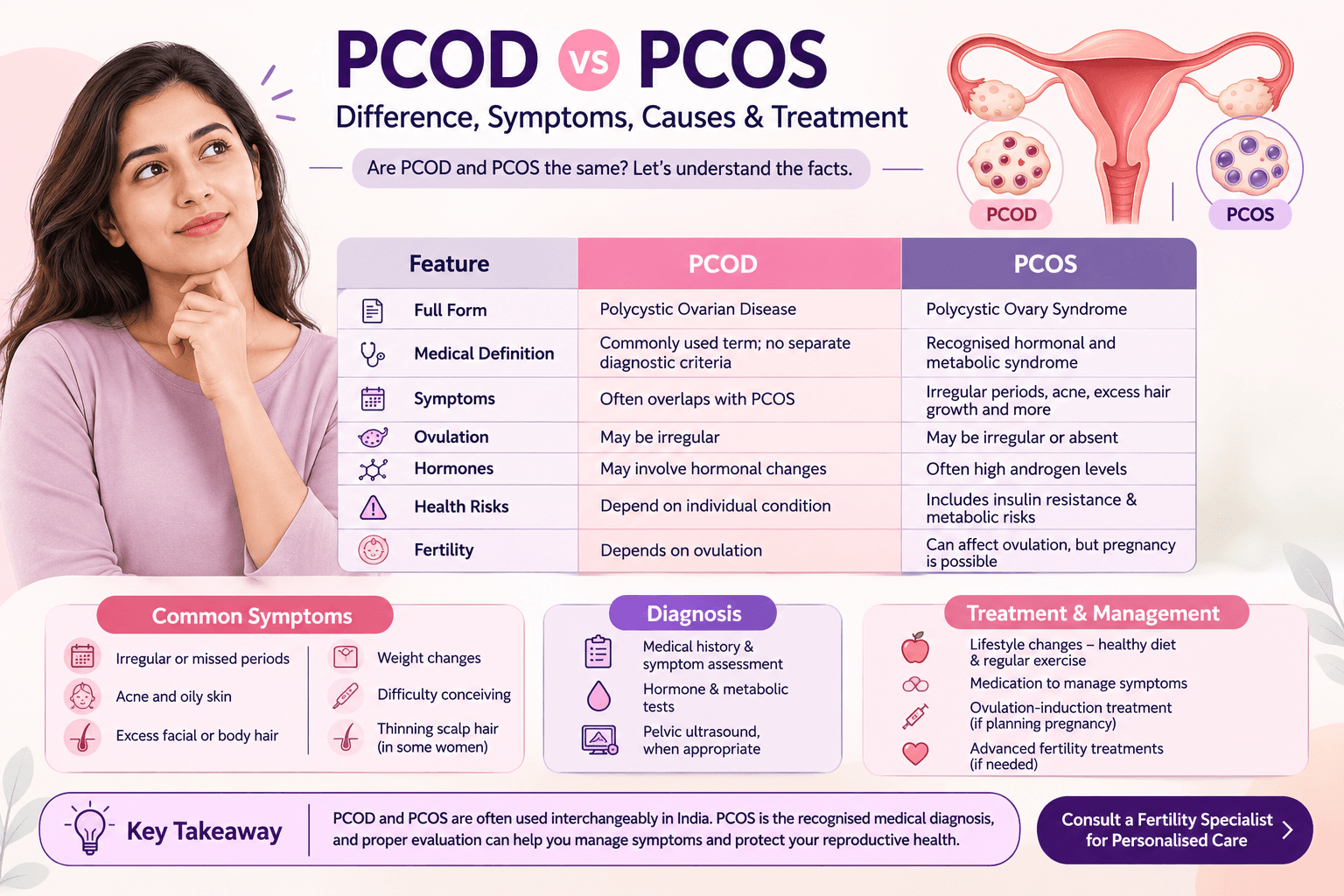
PCOD and PCOS are common terms women come across when experiencing irregular periods, hormonal changes, acne, unwanted facial hair or difficulty getting pregnant. Although these terms are often used interchangeably in India, many women wonder whether PCOD and PCOS are the same or if there is a difference between them.
PCOD stands for Polycystic Ovarian Disease, while PCOS stands for Polycystic Ovary Syndrome. PCOS is a medically recognised hormonal and metabolic condition. PCOD is a commonly used term in India, but it does not have a universally accepted medical definition as a separate condition.
Both terms are associated with ovarian and hormonal health, and their symptoms can overlap. However, it is important to understand that PCOD is not medically established as a milder form of PCOS.
In this article, we explain the difference between PCOD and PCOS, their full forms, common symptoms, causes, diagnosis, treatment options and how they may affect a woman's chances of getting pregnant.
What Is PCOD?
PCOD stands for Polycystic Ovarian Disease. It is a commonly used term in India to describe ovarian and hormonal changes that may be associated with irregular periods, changes in ovulation and the presence of multiple small follicles in the ovaries.
Women who are told they have PCOD may experience menstrual irregularities, acne, weight changes, unwanted facial hair or difficulty predicting their ovulation.
However, PCOD does not have a separate, universally accepted diagnostic definition. Doctors therefore need to assess the actual symptoms and test results to understand the underlying condition.
Common Symptoms of PCOD
Symptoms can differ from one woman to another. Some commonly reported symptoms include:
- Irregular or delayed menstrual periods.
- Weight gain or difficulty managing weight.
- Acne and oily skin.
- Unwanted facial or body hair.
- Hair thinning or hair loss.
- Difficulty predicting ovulation.
- Difficulty getting pregnant in some cases.
Not every woman experiences all these symptoms. The presence of multiple small follicles on an ultrasound alone does not mean that a woman has PCOD or PCOS.
What Is PCOS?
PCOS stands for Polycystic Ovary Syndrome. It is a hormonal and metabolic condition that affects how the ovaries function and how the body regulates certain hormones.
Women with PCOS may have higher levels of androgens (hormones such as testosterone), irregular periods and problems with regular ovulation.
Some women with PCOS also have insulin resistance. This means the body does not respond to insulin as effectively as it should, which can affect blood sugar levels and hormonal balance.
PCOS can affect women of different body weights. It may also cause different symptoms at different stages of life.
Common Symptoms of PCOS
The symptoms of PCOS may include:
- Irregular, infrequent or missed periods.
- Excessive facial or body hair.
- Persistent acne or oily skin.
- Hair thinning, particularly on the scalp.
- Weight gain or difficulty losing weight.
- Dark, thickened skin around the neck, underarms or other body folds.
- Difficulty with regular ovulation.
- Difficulty getting pregnant.
- Insulin resistance or other metabolic concerns.
Some women may have PCOS without experiencing obvious symptoms. Others may have regular periods but still show signs of hormonal imbalance.
PCOD vs PCOS: What Is the Difference?
The main difference between PCOD and PCOS is their medical classification.
PCOS is a recognised hormonal and metabolic syndrome with established diagnostic criteria. PCOD is a commonly used term in India, but it is not recognised as a separate condition with standardised diagnostic criteria.
Here is a simple comparison to understand the difference between PCOS and PCOD.
Feature | PCOD | PCOS |
Full form | Polycystic Ovarian Disease | Polycystic Ovary Syndrome |
Medical classification | Commonly used term without separate universal diagnostic criteria | Recognised hormonal and metabolic syndrome |
Hormonal changes | Depend on the underlying condition | Androgen levels may be higher than normal |
Periods | May be irregular or delayed | May be irregular, infrequent or absent |
Ovulation | May be irregular | Irregular or absent ovulation is common |
Ovarian appearance | Multiple small follicles may be reported | Polycystic ovarian appearance may be present, but is not essential for diagnosis |
Metabolic health | Depends on the underlying findings | Increased risk of insulin resistance and other metabolic problems |
Fertility | Depends on ovulation and other reproductive factors | May affect fertility, particularly when ovulation is irregular |
Treatment | Depends on the actual diagnosis and symptoms | Lifestyle changes, medication and fertility treatment when required |
Important: This comparison explains how the terms are commonly used. It does not mean that PCOD and PCOS are two separate conditions with fixed differences in severity.
Is PCOD Milder Than PCOS?
Many websites describe PCOD as a milder condition and PCOS as a more serious hormonal disorder. However, this distinction is not supported by universally accepted medical criteria.
There is no established medical classification that defines PCOD as mild and PCOS as severe.
For example, a woman described as having PCOD may experience significant menstrual irregularities or difficulty with ovulation. Another woman diagnosed with PCOS may have relatively mild symptoms.
The seriousness of a woman's condition depends on her symptoms, hormonal health, ovulation pattern and metabolic risk factors, rather than the label alone.
Are PCOD and PCOS Caused by Lifestyle?
Lifestyle factors can influence hormonal and metabolic health, but they are not the only causes of PCOS.
Genetic factors, hormonal changes and insulin resistance may all contribute to PCOS. Women who are lean or have a healthy body weight can also develop the condition.
Healthy eating and regular physical activity can help manage symptoms and improve overall health. However, it is not medically accurate to say that PCOD is caused only by an unhealthy lifestyle or that it can always be reversed through diet and exercise.
Why Are PCOD and PCOS Often Confused in India?
PCOD and PCOS are frequently used interchangeably in everyday conversations, medical consultations and online health information in India.
Many women receive an ultrasound report mentioning multiple small follicles and are told that they have PCOD. However, the presence of these follicles alone is not enough to diagnose PCOS.
PCOS is diagnosed by looking at a combination of symptoms, hormone levels and, when needed, ultrasound findings.
This is why two women with similar ultrasound reports may receive different medical assessments.
If you have been diagnosed with PCOD, it is worth discussing your menstrual history, hormone levels and overall health with a gynaecologist or fertility specialist to understand what the findings actually mean.
What Causes PCOD and PCOS?
The exact cause of PCOS is not fully understood. However, several factors are believed to contribute to the condition.
1. Hormonal Imbalance
Women with PCOS may have higher levels of androgens, sometimes called male hormones, although women naturally produce these hormones too.
Higher androgen levels can affect ovulation and contribute to acne, unwanted facial hair and hair thinning.
2. Insulin Resistance
Insulin helps the body use glucose from food for energy. In some women with PCOS, the body does not respond properly to insulin.
As a result, the body may produce more insulin to maintain normal blood sugar levels. Higher insulin levels can increase androgen production and affect ovulation.
However, not every woman with PCOS has insulin resistance.
3. Genetic Factors
PCOS can run in families. Women whose mother or sister has PCOS may have a higher chance of developing the condition.
However, having a family history does not mean that every woman will develop PCOS.
4. Metabolic and Lifestyle Factors
Physical inactivity, poor sleep and certain lifestyle habits can affect metabolic health.
In women with PCOS, excess body weight may worsen some symptoms and metabolic problems. However, weight is not the only factor, and PCOS can also occur in women who are lean.
How Are PCOD and PCOS Diagnosed?
There is no single test that can confirm PCOS in every woman. A doctor usually considers menstrual history, symptoms, physical examination and relevant test results.
For adults, PCOS is generally diagnosed when at least two of the following three features are present, after ruling out other possible causes:
1. Irregular or Absent Ovulation
A woman may experience irregular periods, long gaps between periods or missed periods because the ovaries are not releasing eggs regularly.
2. Higher Androgen Levels
The doctor may look for symptoms such as unwanted facial or body hair, persistent acne or scalp hair thinning.
Blood tests may also be recommended to check androgen levels.
3. Polycystic Ovarian Appearance on Ultrasound
An ultrasound may show an increased number of small follicles or increased ovarian volume.
These are usually small ovarian follicles, not conventional ovarian cysts.
Not every woman with PCOS has this ultrasound appearance. Similarly, having this appearance does not automatically mean that a woman has PCOS.
Common Tests Recommended for PCOS
Depending on the symptoms and medical history, a doctor may recommend:
- Hormone tests, including testosterone levels.
- Thyroid function tests.
- Prolactin testing.
- Blood glucose or HbA1c testing.
- Lipid profile to check cholesterol levels.
- Pelvic ultrasound, when required.
- Additional tests to rule out other hormonal conditions.
Anti-Müllerian Hormone (AMH) may be used as an alternative to ultrasound for assessing polycystic ovarian morphology in appropriate adult patients. However, AMH alone cannot diagnose PCOS.
For teenagers, diagnosis requires additional care because irregular periods and hormonal changes can be part of normal puberty. Ultrasound and AMH should not be used to diagnose PCOS in adolescents.
Can PCOD or PCOS Affect Fertility?
Yes, PCOS and the underlying hormonal changes sometimes described as PCOD can affect fertility, particularly when they interfere with regular ovulation.
Ovulation is the process in which an ovary releases an egg. For natural pregnancy to occur, an egg needs to be released and fertilised by sperm.
When ovulation is irregular or absent, it can become difficult to predict the fertile days of the menstrual cycle.
However, having PCOS does not mean that a woman cannot get pregnant.
Other factors, such as age, ovarian reserve, fallopian tube health and sperm quality, also play an important role in conception.
Can Women With PCOS Get Pregnant Naturally?
Yes. Many women with PCOS get pregnant naturally.
Some women with PCOS continue to ovulate regularly, while others may release eggs less frequently.
If ovulation is irregular, a fertility specialist may recommend lifestyle changes, ovulation monitoring or medication to support egg release.
The right approach depends on the woman's age, reproductive health and other fertility factors.
Does PCOS Increase the Risk of Pregnancy Complications?
Women with PCOS may have a higher risk of certain pregnancy-related complications, including:
- Gestational diabetes.
- High blood pressure during pregnancy.
- Preeclampsia.
- Miscarriage.
- Preterm delivery.
These complications do not happen to every woman with PCOS. Pre-pregnancy counselling, appropriate health checks and regular antenatal care can help identify and manage individual risks.
What Are the Treatment Options for PCOD and PCOS?
Treatment depends on the woman's symptoms, test results, overall health and whether she is planning to become pregnant.
There is no single treatment that works for every woman.
1. Lifestyle Changes
Healthy lifestyle habits are an important part of managing PCOS.
Doctors may recommend:
- Eating a balanced diet with adequate protein, fibre and essential nutrients.
- Including regular physical activity.
- Maintaining a consistent sleep schedule.
- Managing weight where medically appropriate.
- Monitoring blood sugar and cholesterol levels.
These changes can improve overall health and help manage some PCOS symptoms. Benefits can also occur without weight loss.
2. Medication for Hormonal Symptoms
Depending on the symptoms and whether pregnancy is being planned, doctors may prescribe medication to:
- Regulate menstrual cycles.
- Manage acne and unwanted facial hair.
- Protect the lining of the uterus when periods are very infrequent.
- Improve insulin sensitivity when clinically indicated.
Medication should always be taken under medical supervision.
3. Ovulation Induction Treatment
Women with PCOS who are trying to conceive may need medication to help the ovaries release eggs regularly.
Letrozole is generally recommended as the first-choice medication for women with PCOS-related ovulation problems when there are no other infertility factors.
The treatment should be prescribed and monitored by a fertility specialist.
4. Advanced Fertility Treatments
If pregnancy does not occur with initial treatment, or if other fertility problems are identified, additional treatments may be considered.
These include:
- Intrauterine Insemination (IUI): In selected cases, prepared sperm is placed inside the uterus around the time of ovulation.
- In Vitro Fertilisation (IVF): Eggs are collected from the ovaries and fertilised with sperm in a laboratory. The resulting embryo is then transferred into the uterus.
Not every woman with PCOS needs IUI or IVF. Many women can conceive with appropriate initial treatment.
When Should You Consult a Fertility Specialist?
You should consider consulting a gynaecologist or fertility specialist if you experience:
- Periods that are consistently irregular or absent.
- Long gaps between menstrual cycles.
- Persistent acne or unwanted facial hair.
- Unexplained changes in weight.
- Difficulty predicting ovulation.
- Difficulty getting pregnant.
- Repeated menstrual irregularities or other hormonal concerns.
If you are trying to conceive, you do not need to wait for a long time before seeking help when you already have irregular or absent periods.
An early fertility assessment can help identify whether ovulation is the main concern or whether other reproductive factors need attention.
Take the Next Step Towards Better Reproductive Health
Irregular periods, hormonal changes and difficulty conceiving should not be ignored. Understanding the reason behind these symptoms is the first step towards receiving the right care.
At Oasis Fertility, women can consult fertility specialists for reproductive health assessments, ovulation-related concerns and personalised fertility treatment planning.
If you have been diagnosed with PCOD or PCOS and are planning pregnancy, a fertility consultation can help you understand your reproductive health and explore suitable options.
Book a consultation with an Oasis Fertility specialist to discuss your concerns and plan your next steps.
Medical disclaimer: This article is intended for educational purposes only. It should not replace professional medical advice, diagnosis or treatment. Always consult a qualified healthcare professional for individual medical guidance.