






As a woman, not being able to conceive can be mentally and emotionally stressful. A blockage in the fallopian tubes can be one of the reasons. This condition has been studied and medical science has made significant strides in reproductive health and it can be treated. A painless HSG test helps fertility doctors determine the cause of infertility to design a conception plan.
What is an HSG test?
HSG, stands for Hysterosalpingogram, which is an X-ray procedure to assess the inside of the female reproductive organs. It is an efficient method to evaluate any abnormalities inside the uterus and fallopian tubes. It involves injecting a contrast dye into the uterus, which, upon being subjected to low-dose X-rays, gives insights about the shape and structure of the uterine cavity and fallopian tubes.
Why is an HSG test done?
To diagnose uterine conditions:
HSG test is performed as part of the infertility diagnosis to examine the uterus for congenital uterine anomalies, fibroids, tumours, polyps, adhesions, scarring in the pelvis as these conditions might impact implantation and embryo growth.
To check the success of a tubal ligation process:
It is also done to confirm if the tubes are completely blocked after a tubal ligation procedure (a procedure wherein the fallopian tubes are tied to prevent pregnancy).
To check for blockages in the Fallopian Tubes:
Blocked fallopian tubes are one of the major causes of infertility in women. Blockages in the fallopian tubes can be due to the presence of mucous, cell debris, polyps, and fibroids. These blockages won’t allow the sperm to reach the egg for fertilization, or the fertilized egg can’t reach the uterus for implantation and may result in an ectopic pregnancy. These blockages in the fallopian tubes can be diagnosed with the help of an HSG test.
When does the Doctor Perform the HSG?
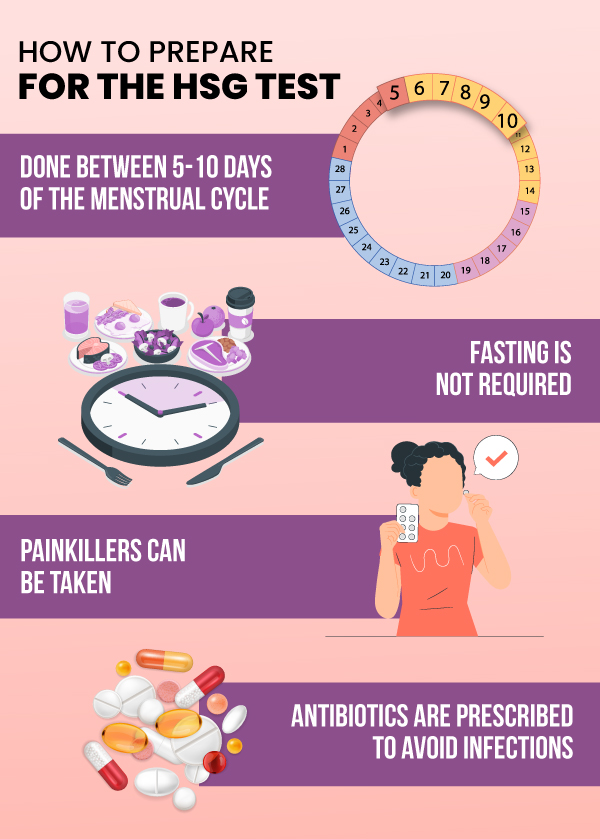
You can expect the HSG test to be scheduled between the last day of the periods and before the start of ovulation, i.e. days 5-10 of the menstrual cycle (this period might vary depending on the length of the menstrual cycle).
Is the HSG Test Necessary?
Your fertility doctor will decide this, particularly if there are signs of tubal issues, e.g., prior pelvic infection, known endometriosis, previous ectopic pregnancy, or unexplained infertility.
However, it isn’t always mandatory, your fertility specialist will consider your history, symptoms, and other investigations. If your tubes are known to be open and there are no uterine issues, the test may be deferred or replaced by other imaging. The decision should always be personalised.
What to expect before an HSG test?
Your healthcare provider reviews your personal medical history before the HSG to determine if it is suitable to perform the test on you. If your doctor has been tracking your Luteinizing Hormone (LH) levels and has confirmed you are not pregnant, your provider may review these results in preparation for your upcoming HSG.
Your provider will also outline the possible risk of complications associated with the HSG test, although the risks are very low. They will review your past medical history and the identification of your allergy status prior to performing an HSG test.
Step-by-Step Process of the HSG Test
HSG takes under 45 minutes from start to finish:
- The diagnostician will position you on the exam table, just like any gynaecology exam.
- They place a speculum in the vagina and insert a catheter through it to inject medication.
- Slowly contrast dye is injected till it covers the lining of the uterus and fallopian tubes.
- A radiologist takes an X-ray image to discover abnormalities or blockages that may affect the patient’s fertility.
What to expect after the HSG test?
It is important to remember that these side effects usually resolve within a few days after the procedure.
- Might experience slight discomfort in the pelvic area (If the pain persists consult with your fertility specialist)
- Abdominal pain or cramping
- Sticky vaginal discharge (due to the dye)
- Mild bleeding or spotting
- Dizziness
- Nausea
What are the risks of the HSG test?
An HSG test is relatively safe, but rare complications may include:
- An allergic reaction to the contrast dye
- Infection of the uterus and fallopian tubes
- Perforation of the uterus
- A small amount of abnormal bleeding (If it persists more than a few hours and is heavier than periods, consult with your doctor)
- Fever or chills
Is the HSG test a painful procedure?
HSG test majorly is a painless procedure and the experience may vary from woman to woman due to their respective pain tolerance levels. In a few women the procedure might cause mild discomfort. The dye is introduced painlessly through the vagina into the uterus and fallopian tubes. Few women may experience slight cramping while injecting the dye.
Over-the-counter pain medications can help in alleviating the discomfort.
Who should avoid the HSG test?
Women should avoid getting an HSG test in case of
- Pregnancy
- Pelvic inflammatory disease (PID)
- Unexplained vaginal bleeding
Can an HSG test improve the chances of pregnancy?
The HSG test does not directly boost the chances of conception. It can answer some fertility-related questions, which in turn can be treated. It is safe to try for up to 3 months after the procedure. In such instances, it is assumed that the contrast dye (iodine) used during the procedure might help in clearing out the mucous or other cell debris that could be blocking the fallopian tube and preventing pregnancy. Although it can be a pleasant side effect, it is important to remember that it might not be a necessary outcome.
Is the HSG test the only option?
There are other procedures, such as Laparoscopy and Hysteroscopy. They are used to diagnose problems arising due to issues in the uterine cavity, but they don’t give any information about the blockages in the fallopian tubes.
HSG test is also considered in cases of recurrent miscarriages and abnormal bleeding.


fill up the form to get a
Free Consultation
Avail 0% interest on EMI
All Procedures | No Upper Limit
Frequently Asked Questions
What is an HSG Test used for?
Are there risks associated with the HSG Test?
What does an HSG test detect?
What happens if my fallopian tubes are blocked?
Is HSG done under anesthesia?
Does HSG delay the next period?
Can the HSG Test detect all fertility issues?
What happens if the test shows blocked tubes?
How soon will I get HSG results?
Is the HSG test useful for pregnancy?
What is the “10-day rule” for HSG?
How does the HSG test help with conception?
When should I consider getting an HSG test?
How soon can I try to conceive after an HSG test?
Related posts